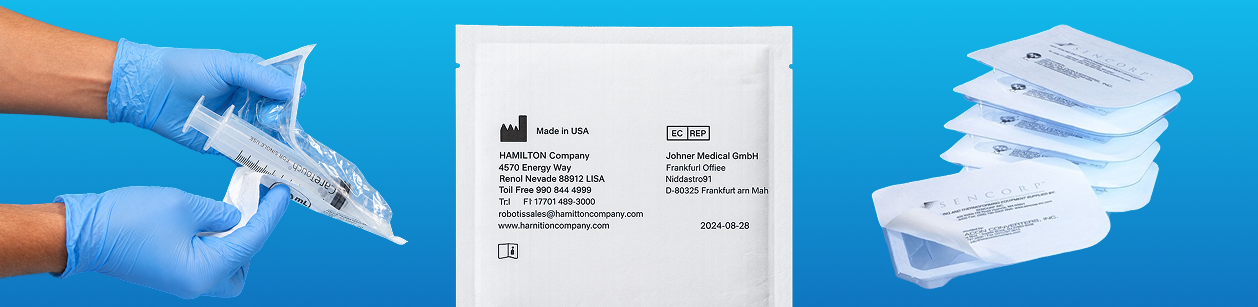
Tyvek has become one of the most trusted materials for medical sterile packaging, widely used across healthcare, pharmaceutical, and high-value product industries. But when it comes to coding for Tyvek medical packaging, manufacturers face unique challenges that many traditional systems struggle to overcome.
What is Tyvek and Why Is It Used in Medical Packaging?
Tyvek® is a 100% synthetic material made from high-density polyethylene fibers, engineered to combine the best properties of paper, film, and fabric.
Its unique structure delivers a rare combination of performance benefits:
- Superior microbial barrier to maintain sterility
- Breathability that allows sterilization gases to penetrate
- High tear and puncture resistance for durability in transit
- Low linting and cleanliness for controlled environments
- Compatibility with multiple sterilization methods (EO, gamma, steam)
Because of these properties, DuPont™ Tyvek® is widely used for:
- Medical device packaging (surgical tools, implants, catheters)
- Pharmaceutical packaging
- Diagnostic kits and biologics
- Cleanroom and sterile barrier systems
In short, Tyvek is critical where sterility and product integrity cannot be compromised.

Key Applications for Markoprint on Tyvek
Markoprint TIJ systems are ideal for:
- Medical device pouches (Tyvek + film lids)
- Sterile barrier packaging
- Pharmaceutical and diagnostic kits
- Cleanroom packaging materials
- Tyvek lids on trays and thermoformed packaging
Why Markoprint TIJ Excels at Coding on Tyvek
Printing on Tyvek is not the same as printing on paper or corrugate. It’s nonwoven, slightly textured, polymer surface creates challenges for many coding technologies.
Markoprint TIJ stands out as one of the best-fit solutions:
High-Resolution Coding for Compliance
Markoprint TIJ produces sharp, high-resolution codes, ensuring:
- Readable barcodes and Data Matrix codes
- Reliable UDI compliance
- Clear lot coding and expiration data (date coding)
Clean, Non-Contact Coding
Because Tyvek is used in sterile environments, Markoprint offers:
- Non-contact coding with no mechanical stress
- Reduced contamination risk
- Clean operation without ribbons or excess fluids
Optimized Ink Adhesion on Tyvek
Specialized TIJ inks are designed for synthetic materials like Tyvek, providing:
- Fast drying times
- Strong adhesion
- Resistance to smudging and abrasion
Compact Integration for Packaging Lines
Markoprint systems integrate easily into:
This makes them ideal for inline coding for Tyvek medical packaging.
The Challenge: Printing on Tyvek Isn’t Easy
Despite its benefits, Tyvek creates real challenges for manufacturers.
- Ink adhesion variability
- Surface texture inconsistencies
Manufacturers have a need for high-quality, scannable codes which are possible with Markoprint. Printheads range from ½-inch to 4.25-inches tall and can be integrated despite space constraints on most packaging lines. This is where many traditional coding systems fall short.
How Markoprint Solves Tyvek Coding Pain Points
Markoprint X1Jet systems, especially the X1Jet MK3, X1Jet LX Ultra and Integra PP108 are specifically designed to overcome the challenges associated with coding for Tyvek medical packaging.
Simplified Printhead Design
Most traditional TIJ systems require multiple stitched printheads to achieve larger print heights, increasing complexity and maintenance.
Markoprint solves this with:
- Up to 4.25″ print height in a single printhead
- No stitching or alignment issues
- Simpler installation and operation
Result: Less complexity, fewer failure points, and lower total cost.
Reliable Coding on Tyvek Surfaces
Coding on Tyvek can be difficult due to its textured, nonwoven structure.
Markoprint systems deliver:
- Consistent drop placement on Tyvek
- Compatibility with specialty inks for synthetic materials
- High-resolution output for barcodes and UDI compliance
Result: Clear, scannable codes for medical packaging applications.
Seamless Integration into Packaging Equipment
Markoprint systems are built for real-world production environments and integrate easily into:
Result: Faster installation and minimal disruption to production lines.
Reduced Downtime and Maintenance
Compared to other coding technologies:
- No ribbons required (vs thermal transfer)
- No complex fluid systems (vs CIJ)
- Cartridge-based ink for quick replacement
Result: Increased uptime and easier operator training.
Final Thoughts
Tyvek continues to grow as a critical material for high-performance packaging, especially in regulated industries like healthcare and pharmaceuticals.
But with that growth comes increased demands on printing systems:
- Higher code quality
- Greater reliability
- Simpler integration
Markoprint meets these demands head-on.
With high-resolution inkjet printing, printhead alternatives from 1/2″ to 4.25″, and proven integration flexibility, Markoprint provides a smarter, more efficient solution for manufacturers printing on Tyvek.
FAQ's
Q: Is Tyvek Use Growing in Packaging?
A: Yes—and for good reason.
The demand for Tyvek continues to grow due to several industry trends:
- Stricter regulatory requirements in medical and pharmaceutical packaging
- Increased focus on sterility assurance and patient safety
- Growth in single-use medical devices and kits
- Expansion of biologics and advanced therapies
- Rising need for durable, contamination-resistant materials
Tyvek has become the preferred material for many medical device manufacturers because it reliably maintains sterility while withstanding harsh sterilization and distribution environments.
As global healthcare production scales, so does the need for reliable, high-performance packaging—making Tyvek a long-term growth material.