Barcodes are machine-readable symbols used to identify products, packaging, shipments, assets, and manufacturing data throughout the supply chain. Different barcode types are designed for different applications, ranging from retail checkout and inventory tracking to industrial product identification and pharmaceutical traceability.
Today, barcodes generally fall into two categories: linear 1D barcodes: Code 128, Code 39, ITF-14, UPC-A, EAN-13, and GS1-128. and two-dimensional 2D barcodes: DataMatrix, GS1DataMatrix, QR Codes, GS1-QR Codes. Each type is designed for specific applications and data requirements.

Linear barcodes, also known as 1D (one-dimensional) barcodes, store information using a series of vertical bars and spaces that vary in width. They are called 1D because data is encoded in a single horizontal direction, unlike 2D barcodes (such as QR Codes) that store information both horizontally and vertically. Linear barcodes are widely used for product identification, retail, inventory management, shipping, manufacturing, and logistics due to their simplicity, fast scanning, and broad compatibility. Common 1D barcode types include Code 128, Code 39, ITF-14, UPC-A, EAN-13, and GS1-128.
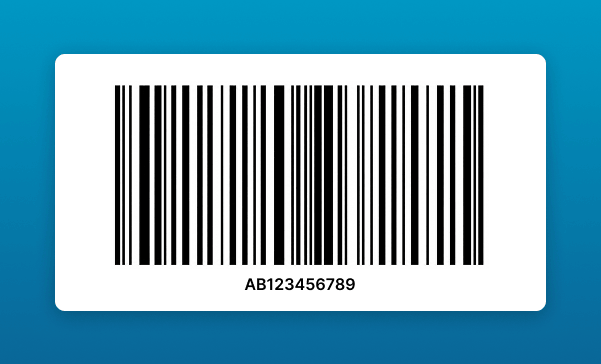
Code 128 is a high-density, continuous, variable-length linear barcode capable of encoding the full 128 ASCII character set, including letters, numbers, and special characters, in a single symbol. Using three character subsets (A, B, and C), it optimizes data storage and can encode large amounts of information in a compact space, making it a popular choice for logistics, warehousing, supply chain, shipping, and inventory management applications.
GS1-128 is a standardized implementation of Code 128 that uses a special FNC1 character and GS1 Application Identifiers (AIs) to encode structured data such as GTINs, expiration dates, batch numbers, and serial numbers. Multiple AIs can be combined in a single barcode, making GS1-128 ideal for warehousing, logistics, manufacturing, food & beverage, healthcare, and supply chain traceability. It is the required barcode format for pallet labels and shipping cartons under GS1 standards.
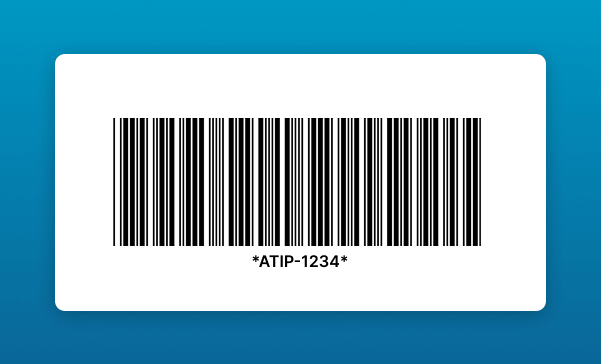
Code 39 is one of the oldest barcode symbologies still in use. It supports uppercase letters, numbers, and several special characters. Unlike Code 128, Code 39 is easier to generate and does not require a checksum by default, but it requires more space to encode the same amount of data. Its reliability and broad scanner compatibility have made it a longstanding standard in manufacturing, asset tracking, and industrial applications.
ITF-14 is a numeric-only barcode used to encode 14-digit GTINs on corrugated cases and secondary packaging. It uses the Interleaved 2 of 5 barcode format, which encodes numbers in pairs to save space while maintaining reliable scanning performance. It surrounded by a thick rectangular border, known as a bearer bar, which helps prevent scanning errors and makes the symbol especially reliable when printed directly on cardboard boxes.
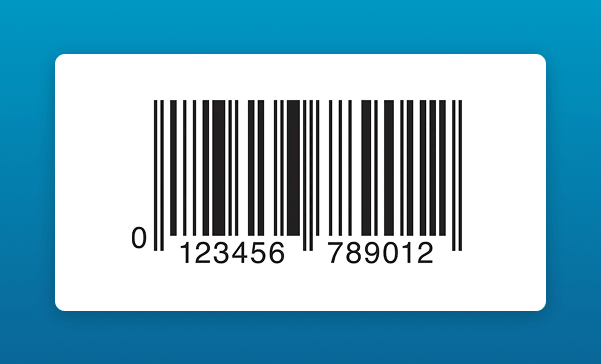
UPC-A (Universal Product Code) is the standard retail barcode used throughout the United States and Canada. It encodes a 12-digit GTIN consisting of a manufacturer identifier, product number, and check digit. Originally developed for the grocery industry in the 1970s, UPC-A remains the most widely scanned barcode in North American retail and is commonly used on consumer packaged goods, food products, health and beauty items, and general merchandise.
EAN-13 (European Article Number) is the international version of UPC-A and the most widely used retail barcode outside North America. It encodes 13 digits consisting of a GS1 prefix, manufacturer code, product code, and check digit (GTIN-13). Commonly used in retail, grocery, consumer goods, healthcare, and logistics, EAN-13 is compatible with UPC-A, allowing both formats to be read by modern barcode scanners. The 13th digit is encoded using a parity pattern, enabling it to fit within the same symbol width as UPC-A.
Unlike linear barcodes, 2D barcodes store information both horizontally and vertically, allowing them to hold significantly more data in a smaller space. They are commonly used for traceability, serialization, product authentication, and consumer engagement.
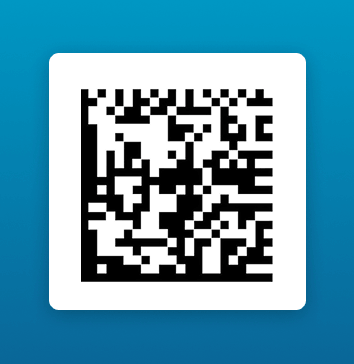
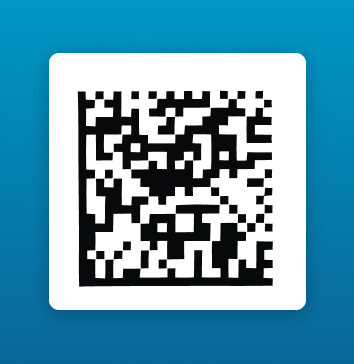
DataMatrix is a high-density 2D barcode capable of storing large amounts of alphanumeric or numeric data in a compact square or rectangular symbol. Unlike 1D barcodes, it stores information both horizontally and vertically, allowing more data to fit in less space. Built-in Reed-Solomon error correction enables the barcode to remain readable even if part of the symbol is damaged, making it ideal for direct part marking (DPM), product traceability, and industrial manufacturing applications.
GS1 DataMatrix is a standard DataMatrix barcode that follows GS1 standards by embedding structured product information using GS1 Application Identifiers (AIs). It can store data such as a GTIN, expiration date, batch/lot number, and serial number in a single compact symbol. Widely used for pharmaceutical serialization and product traceability, GS1 DataMatrix supports regulations such as the U.S. Drug Supply Chain Security Act (DSCSA) and the EU Falsified Medicines Directive (FMD).
QR Code (Quick Response) is a high-capacity 2D barcode that stores numeric, alphanumeric, binary, and other types of data in a compact square symbol. Its three distinctive corner squares enable fast, omnidirectional scanning from any angle, while built-in error correction helps maintain readability even when partially damaged. In manufacturing and packaging, QR Codes are used for product traceability, serialization, inventory management, quality control, and connecting printed products to digital information.
GS1 Digital Link QR Code is a GS1-compliant QR code that combines product identification and digital information in a single symbol. It can store a GTIN, batch/lot number, serial number, and expiration date while linking users to online product content. As the foundation of GS1 Sunrise 2027, it supports retail checkout, product traceability, and consumer engagement with a single barcode.
| Barcode | Category | Primary Use | Data Capacity | GS1 Sunrise 2027 Ready |
|---|---|---|---|---|
| Code 128 | 1D | Logistics, shipping labels, inventory management | High | No |
| Code 39 | 1D | Asset tracking and industrial identification | Medium | No |
| ITF-14 | 1D | Corrugated cases and secondary packaging | Low | No |
| UPC-A | 1D | Retail products and consumer goods | Low | No |
| EAN-13 | 1D | International retail packaging | Low | No |
| GS1-128 | 1D | Supply chain, pallet labels, and traceability | High | Partial* |
| DataMatrix | 2D | Direct part marking and industrial traceability | Very High | No |
| GS1 DataMatrix | 2D | Serialization and pharmaceutical traceability | Very High | Yes |
| QR Code | 2D | Product information and consumer engagement | Very High | No |
| GS1 Digital Link QR | 2D | Retail checkout, traceability, and consumer engagement | Very High | Yes |
As supply chains become more connected, manufacturers need barcodes that do more than identify a product. Modern packaging often requires additional data, such as GTINs, batch/lot numbers, expiration dates, serial numbers, and traceability information.
To ensure this information is shared consistently across the global supply chain, GS1 develops the barcode standards used by manufacturers, retailers, distributors, and healthcare organizations worldwide.
2D barcodes overcome these limitations by storing significantly more information within a smaller symbol. A single 2D barcode can contain product identification, traceability data, serialization information, and even links to digital content, making it a more efficient solution for today’s manufacturing, packaging, and supply chain operations.
With a single 2D barcode, manufacturers can encode information such as:
Traditional 1D barcodes are ideal for basic product identification but have limited data capacity. 2D barcodes can store significantly more information in a smaller space, enabling better traceability, serialization, product authentication, and consumer engagement.
This transition is being driven by GS1 Sunrise 2027, a global initiative encouraging the adoption of GS1-compliant 2D barcodes, including GS1 DataMatrix and GS1 Digital Link QR Codes, alongside traditional UPC and EAN barcodes.
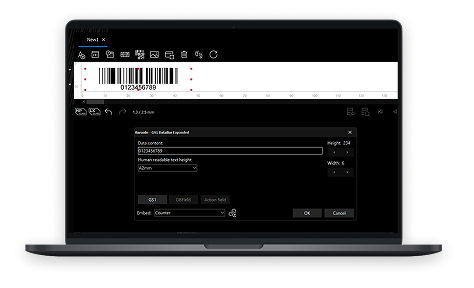
Once you’ve selected the right barcode for your application, the next step is creating and printing it accurately. AT Information Products offers iDesign® software for creating and managing barcode layouts used with Markoprint industrial printing systems.
Supported barcode types include: Code 128, Code 39, Interleaved 2 of 5 (ITF), UPC-A, EAN-13, GS1-128, DataMatrix, GS1 DataMatrix, QR Codes, GS1 Digital Link QR Codes
Download the latest version of iDesign software and begin creating professional barcode layouts in minutes.
Included:
Combined with Markoprint industrial inkjet printers, iDesign enables manufacturers to create and print high-resolution, GS1-compliant barcodes directly onto products, labels, cartons, flexible packaging, and corrugated cases. Contact AT Information Products to learn more about iDesign software and our industrial inkjet printing solutions.
The most common barcode types include Code 128, Code 39, ITF-14, UPC-A, EAN-13, GS1-128, DataMatrix, GS1 DataMatrix, QR Codes, and GS1 Digital Link QR Codes. Each barcode is designed for specific applications, from retail and logistics to manufacturing and product traceability.
1D barcodes store data using a series of vertical bars and spaces, while 2D barcodes store information both horizontally and vertically. This allows 2D barcodes to hold significantly more data in a smaller space, making them ideal for traceability, serialization, and product identification.
Code 128 is a general-purpose linear barcode that can encode letters, numbers, and special characters. GS1-128 uses the same barcode symbology but follows GS1 standards by organizing data with Application Identifiers (AIs), allowing it to encode structured information such as GTINs, batch/lot numbers, expiration dates, and serial numbers.
A standard QR Code can store almost any type of information, including URLs, text, and contact details. A GS1 Digital Link QR Code follows GS1 standards, allowing manufacturers to combine product identification, traceability data, and consumer-facing digital information into a single barcode that supports GS1 Sunrise 2027.
UPC-A is the standard retail barcode in North America, while EAN-13 is the international standard used in most other countries.
UPC-A contains 12 digits and is primarily used in the United States and Canada. EAN-13 contains 13 digits and is the global standard for retail product identification.
A GS1 barcode follows standards developed by GS1, the global organization responsible for barcode and product identification standards. These barcodes can encode structured data such as GTINs, batch/lot numbers, expiration dates, and serial numbers to improve supply chain traceability.
GS1 DataMatrix and GS1 Digital Link QR Codes are the primary barcode formats supporting the GS1 Sunrise 2027 initiative, helping manufacturers prepare for next-generation retail and supply chain requirements.
iDesign® software supports a wide range of 1D and 2D barcode types, including Code 128, Code 39, ITF-14, UPC-A, EAN-13, GS1-128, DataMatrix, GS1 DataMatrix, QR Codes, and GS1 Digital Link QR Codes.
Yes. iDesign® software can generate GS1 DataMatrix and GS1 Digital Link QR Codes, helping manufacturers prepare for GS1 Sunrise 2027 while supporting product traceability, serialization, and regulatory compliance.
Yes. Combined with Markoprint industrial inkjet printers, iDesign enables manufacturers to print high-resolution 1D and 2D barcodes directly onto products, cartons, labels, flexible packaging, and corrugated cases.
Get in touch with us to learn more about our services and how we can assist you. Call us or fill out the form below.
Get in touch with us to learn more about our services and how we can assist you. Call us or fill out the form below.