What Is Flexible Packaging?
Flexible packaging refers to any packaging made from materials that can easily bend, fold, or reshape—such as plastic films, foils, laminates, or coated papers. Unlike rigid containers, flexible formats are lightweight, durable, and customizable, making them ideal for protecting products while reducing material use and shipping costs. These materials typically start as large rolls of film (called rollstock) that are converted into finished bags or pouches through automated machines like form-fill-seal (FFS) systems.
Why Are Pouches Leading the Way?
Pouches are leading the way because they combine performance, sustainability, and convenience. They use less material than traditional packaging, reducing both waste and transportation impact. Pouches also offer strong shelf appeal with printable surfaces and creative shapes, while features like resealable zippers, spouts, and tear notches enhance the consumer experience. This balance of functionality, cost-efficiency, and eco-friendliness has made pouches one of the fastest-growing formats in flexible packaging today.
Why Companies Are Switching to Pouches
Industries from food and beverage to cosmetics, pharmaceuticals, and industrial goods are shifting from rigid containers to flexible pouch packaging because it offers:
Convenience – lightweight, resealable, and easy to open
Sustainability – lower carbon footprint and recyclable options
Branding freedom – high-impact graphics and full-surface printability
- Lower costs – reduced material use, storage, and freight weight
Types of Pouches in Flexible Packaging Coding
Each pouch type serves different purposes based on the product, filling process, and branding needs. Common types include flat 3-side seal, stand-up (doypack), side gusset, stick pack, sachet, quad seal, box, spouted, retrouted, vacuum(pillow bag), and zip lock styles — each offering unique shapes, capacities, and coding requirements.

Flat 3-Side Seal Pouch (pouch Packet)
A flat pouch sealed on three sides with one open end for filling.
Shape: Simple rectangle; no gusset or extra panels
Uses: Single-use food items, coffee, medical supplies, or powders.
Commonly Printed: Product name, logo, nutritional data, batch code, expiration date, and barcodes.
Stand-Up Pouch (Doypack)
A pouch with a bottom gusset that expands, allowing it to stand upright.
Shape: Curved or flat top, rounded bottom gusset for shelf stability.
Uses: Snacks, pet food, beverages, frozen foods, detergents.
Commonly Printed: Branding, reseal instructions, QR codes, and traceability data.
Sachet
A small, flat, single-use pouch similar to a 3-side seal but smaller and thinner.
Shape/Structure: Sealed on all four sides; compact and lightweight.
Uses: Sample products, single-serve sauces, condiments, or pharmaceuticals.
Commonly Printed: Batch codes, lot numbers, and manufacturing dates.
Side Gusset Pouch
A pouch with gussets on both sides to increase capacity while maintaining a sleek profile.
Shape/Structure: Brick-like form when filled.
Uses: Coffee, bulk tea, pet food, and powders.
Commonly Printed: Roast date, lot number, origin details, and barcodes.
Stick Pack
A narrow, tube-shaped pouch designed for single servings.
Shape/Structure: Long and slim with vertical seals.
Uses: Drink mixes, condiments, energy gels, vitamins.
Commonly Printed: Product flavor, nutrition facts, and expiration date.
What Does a Pouch Coding System Do?
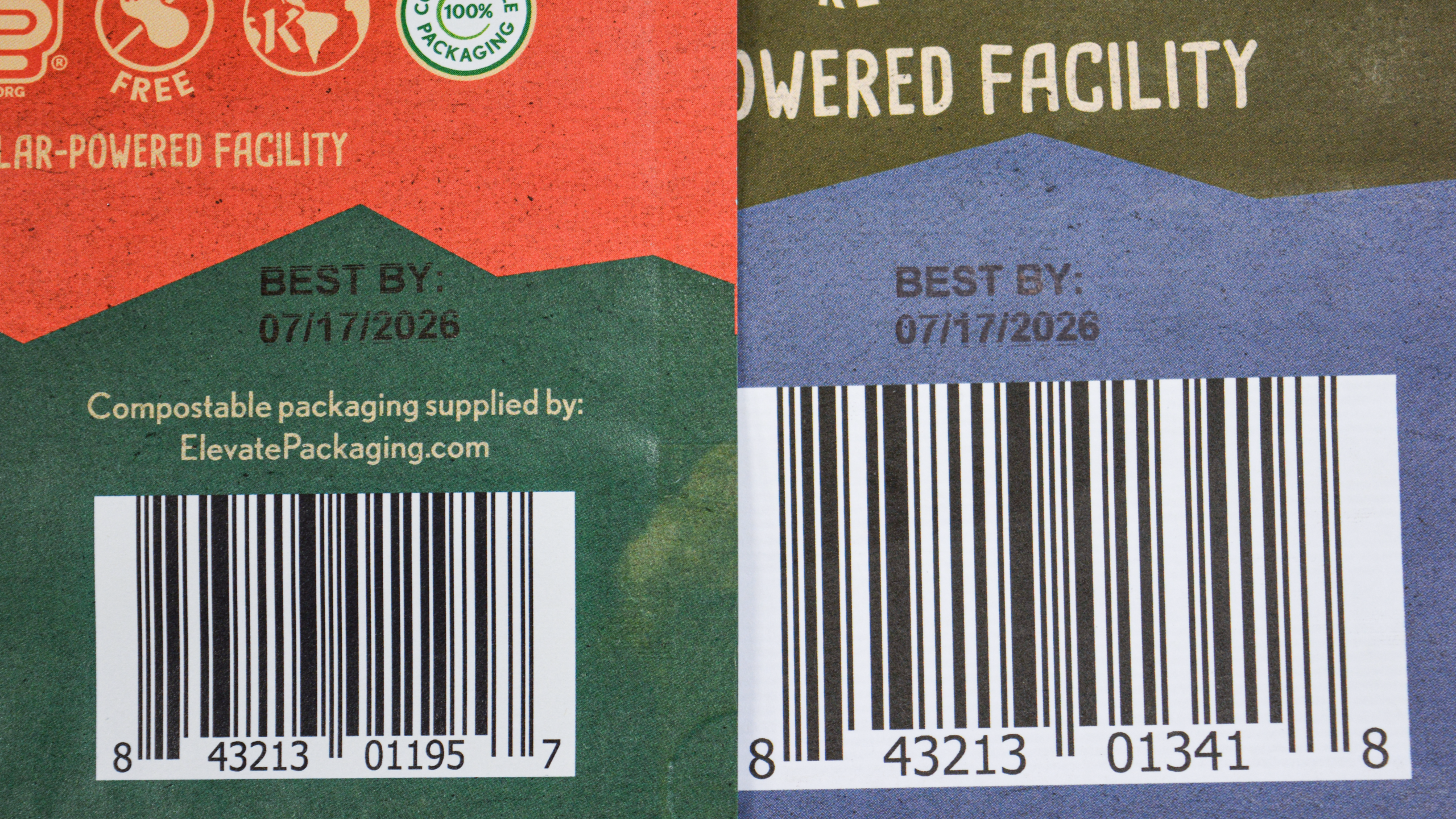
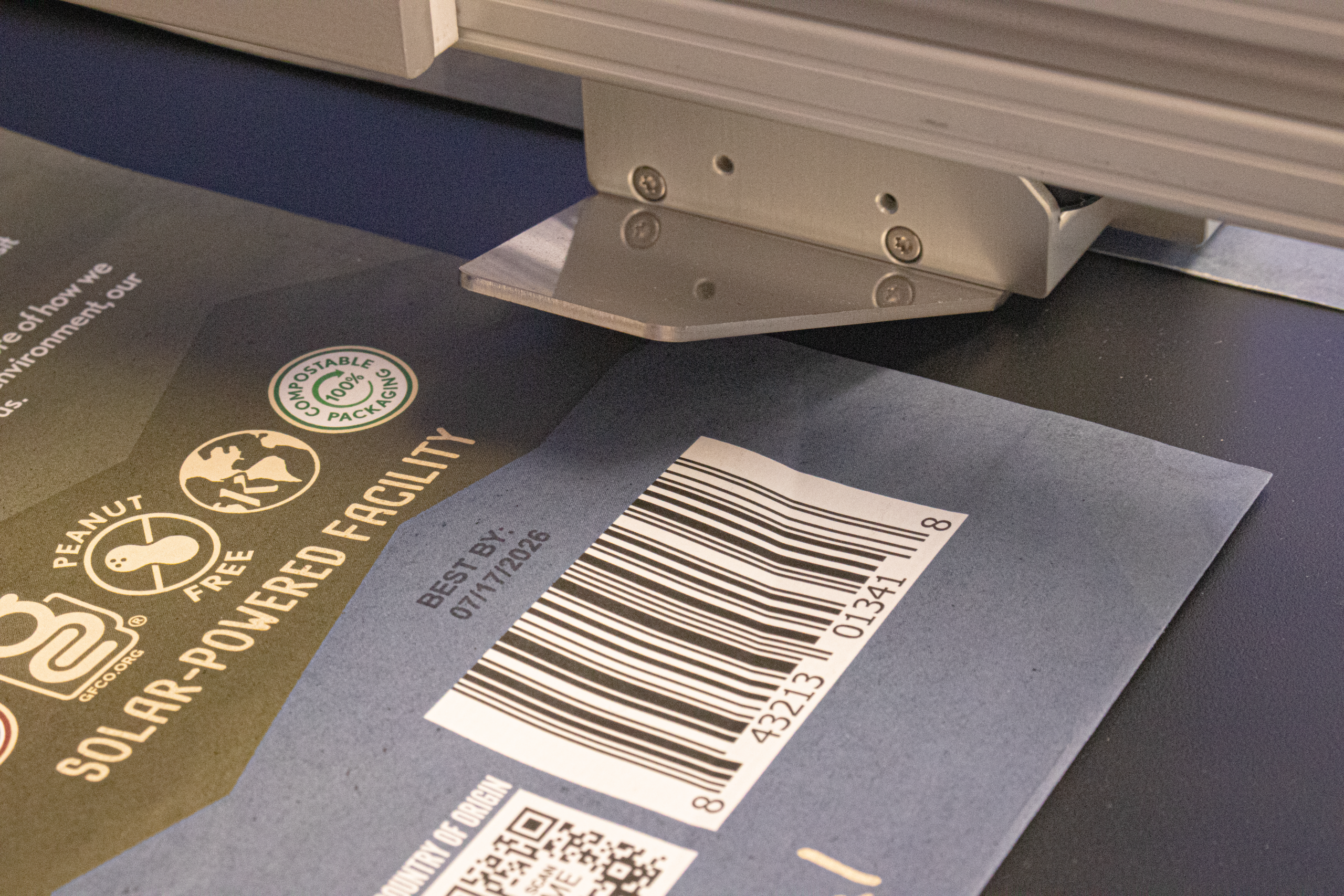
A pouch coding system (or pouch printer) prints essential product information directly onto flexible film or finished pouches. These systems are designed for speed, accuracy, and versatility across materials like plastic, foil, paper, or laminate.

Key Features of Modern Pouch Coding:
High-resolution printing for legible, permanent marks
High-speed operation for continuous packaging lines
Compatibility with various pouch materials and coatings
ADVANTAGES OF THERMAL INKJET (TIJ) TECHNOLOGY FOR POUCH CODING.
Fast-drying inks
Clean, non-contact printing
Minimal maintenance
Food-safe operation
Types of Flexible Packaging Coding Systems
A pouch coding system (or pouch printer) prints essential product information directly onto flexible film or finished pouches. These systems are designed for speed, accuracy, and versatility across materials such as plastic, foil, paper, or laminate. Pouch coding systems are divided into three main categories: manual, semi-automatic, and fully automatic, each offering different levels of automation, throughput, and integration depending on production needs.
Manual
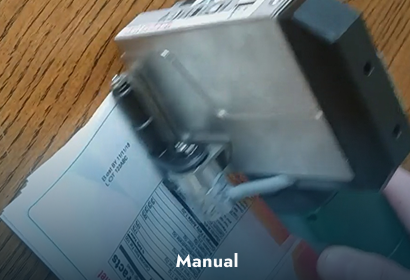
Manual coding or labeling means operators handle each pouch by hand and manually apply prints using a handheld coder or sticker gun. ATIP seeks to replace manual processes with automated systems that reduce labor and improve consistency.
PROs: Minimal setup and low upfront cost, ideal for small batches or short production runs
CONs: Slow throughput and labor-intensive, inconsistent code placement, and difficult to scale for higher volumes
Semi-Automatic
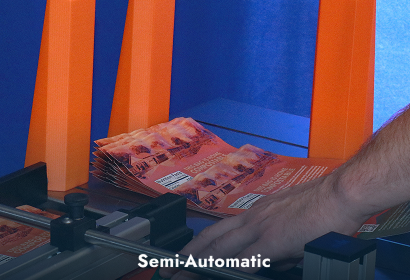
Semi-automatic pouch coding systems require operators to position each pouch manually while the printer automatically applies the code. ATIP’s Pouch Coding System on Conveyor delivers reliable performance, offering a balance between manual control and automated precision.
PROs: Faster and more consistent than manual coding, accurate, repeatable code placement, and good balance between automation and flexibility
CONs: Still requires manual placement and supervision, and moderate throughput—best for medium-volume production
Fully Automatic
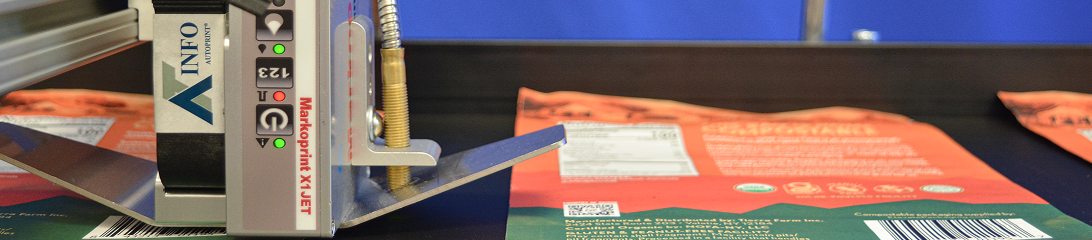
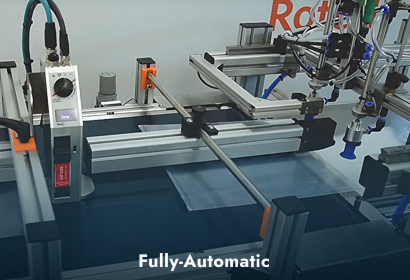
Fully automatic systems integrate directly into the packaging line or operate as offline machines, applying codes automatically during production. ATIP’s RF Pouch System with Markoprint X1Jet or Integra PP RAZR provides high-speed, precise coding with minimal operator input.
PROs: Highest throughput and efficiency, consistent, accurate print placement, and minimal labor requirement and reduced downtime
CONs: Higher initial investment and best suited for high-volume operations
Why Choose AT Information Products (ATIP)
AT Information Products (ATIP) provides flexible pouch packaging coding solutions for manufacturers and packaging operations across the U.S. and Canada. We specialize in high-performance systems designed to print expiration dates, batch codes, barcodes, and traceability data directly onto flexible films, pouches, and other packaging materials. Whether you operate a small facility or a high-speed production line, ATIP delivers manual, semi-automatic, and fully automatic pouch coding systems that ensure speed, accuracy, and compliance. With a strong local presence and nationwide reach, we help businesses improve efficiency, meet labeling requirements, and maintain professional-quality results on every package.
ATIP Advantages:
- Decades of experience with inkjet integrations.
- Compatible inks for plastic film, foils and laminates.
- Solutions for manual, semi-automatic, and inline setups
- Expert support for food, pharmaceutical, pet, and cannabis sectors.
Whether you’re coding expiration dates on sachets, batch numbers on stick packs, or barcodes on stand-up pouches, ATIP delivers precision, reliability, and performance.
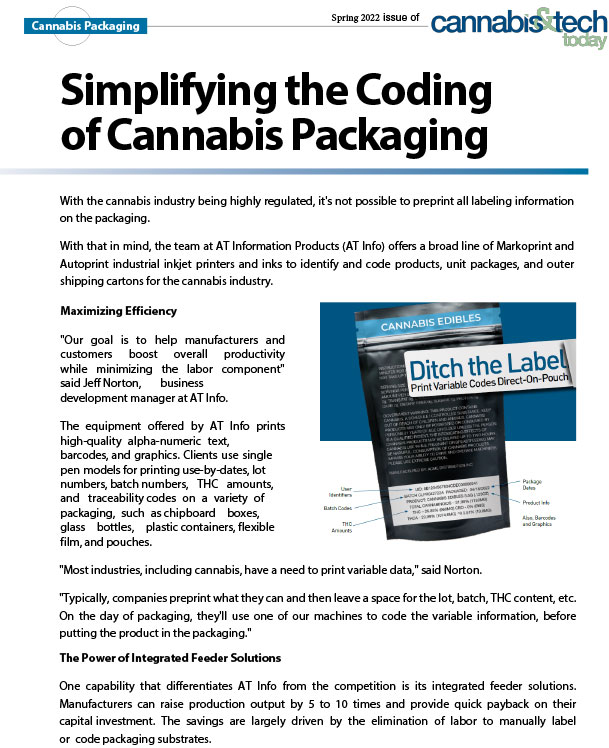
Don’t believe us? Read for yourself — real case studies and examples of our solutions in action.
FAQs About Flexible Packaging Coding
Q: What’s the best printer for flexible packaging?
A: The best printers for flexible packaging are Thermal Inkjet (TIJ) systems, known for their high-resolution print quality, fast-drying inks, and clean operation. AT Information Products (ATIP) offers advanced TIJ-based solutions, including the RF Pouch System for fully automated production lines and the Pouch Coding System on Conveyor for semi-automatic applications. Both deliver precise, permanent codes on flexible materials like plastic, foil, and laminate.
Q: Can you print directly on pouches and films?
A: Yes — ATIP’s pouch coding systems print directly on flexible packaging materials such as plastic, foil, paper, and laminates. The RF Pouch System integrates with automated lines for continuous production, while the Pouch Coding System on Conveyor provides reliable, high-quality coding for mid-volume operations.
Q: What’s the difference between coding and labeling?
A: Coding prints variable information—such as expiration dates, lot numbers, and barcodes—directly onto packaging surfaces, while labeling applies pre-printed stickers. Coding is cleaner, faster, and more efficient for high-volume production environments.
Q: Who is the best flexible packaging coding provider?
A: AT Information Products (ATIP) is a leading U.S. provider of flexible packaging and pouch coding systems, serving industries such as food, beverage, and pharmaceuticals. Our RF Pouch System with Markoprint X1Jet or Integra PP RAZR, and our Pouch Coding System on Conveyor, deliver unmatched precision, reliability, and performance.
Q: What’s the difference between a pouch and a packet?
A: A pouch is a flexible package that can be flat, gusseted, or stand-up, while a packet is typically a smaller, single-use pouch, often referred to as a sachet. In short, all packets are pouches, but not all pouches are packets. Both require accurate coding for compliance and product traceability.
Q: What is batch coding and why is it important?
A: Batch coding (also known as lot or date coding) identifies production batches to support traceability, quality control, and regulatory compliance. Using ATIP’s RF Pouch System or Pouch Coding System on Conveyor, manufacturers can automate this process—ensuring consistent, legible, and permanent codes while reducing manual effort and errors.